
What to Compare Before Choosing Permanent Outdoor Lights
Compare Permanent Outdoor Lighting Systems
Permanent outdoor lighting systems can look similar after dark. Compare StruxLume with other North Alabama systems by power architecture, LED technology, data wiring, brightness, controls, track design, and warranty coverage.
A Comparison Based on Published Specifications
Permanent lighting systems are not always documented the same way. To keep this comparison fair, we use manufacturer-published specifications, publicly available product information, and verified StruxLume system specifications.

Published Data
We use manufacturer and installer specifications whenever they are publicly available.
Apples-to-Apples
Voltage, wattage, lumens, LED architecture, wiring, controls, and warranty are compared as separate specifications rather than treated as interchangeable.
Unknown Means Unknown
If a manufacturer does not publicly specify a measurement, test method, or system feature, we mark it as Not Specified rather than making assumptions.
How the Systems Compare
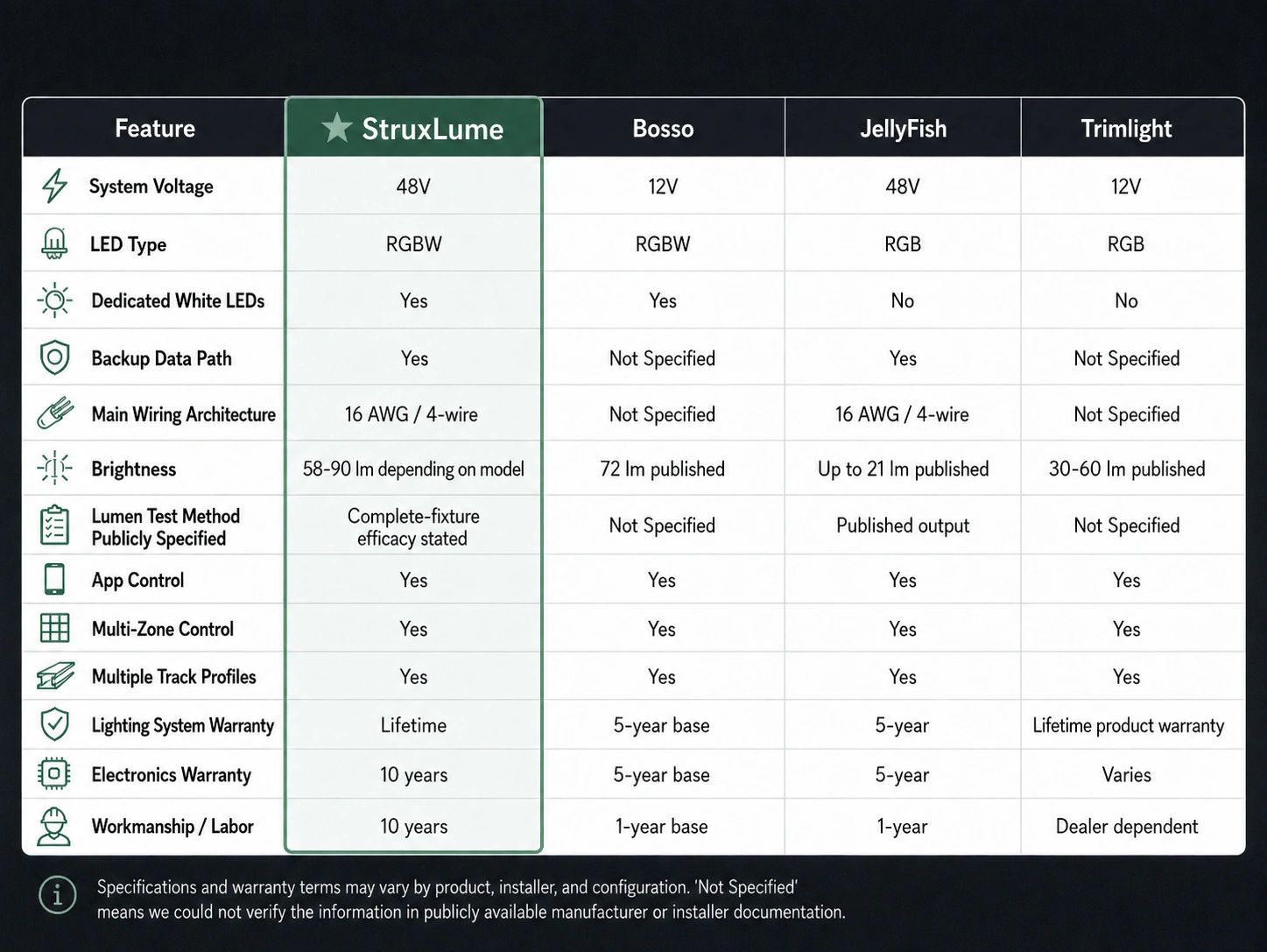
Permanent lighting systems can differ significantly in voltage, LED design, data architecture, brightness, controls, and warranty coverage. The table below summarizes the major differences using publicly available specifications.
At-a-Glance Comparison of Permanent Lighting Systems
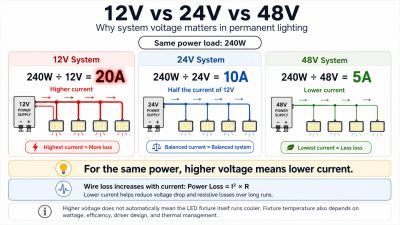
Why this matters on a roofline
Electrical wire loss increases with the square of current:
Power Loss = I² × R
That means reducing current can significantly reduce resistive losses in the wiring.
StruxLume uses a 48V power-distribution architecture. JellyFish also uses 48V, while Bosso and Trimlight use 12V architectures.
Important clarification
Higher voltage does not automatically mean the LED fixture itself runs cooler or lasts longer. Fixture temperature depends on LED wattage, efficiency, driver design, enclosure construction and thermal management.
Brightness Numbers Need Context
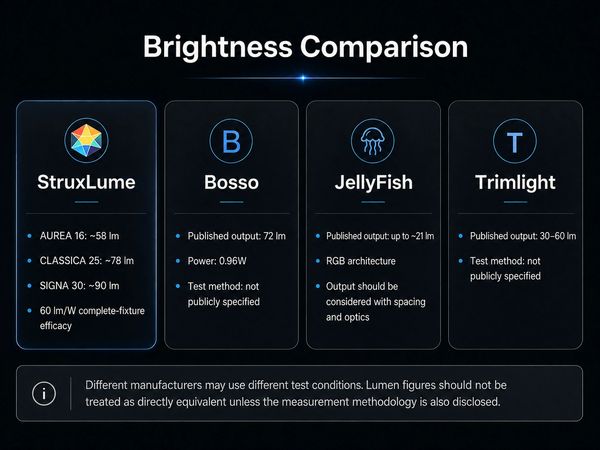
Lumens are useful, but only when you know what the number represents. Permanent-lighting manufacturers do not always publish brightness using the same test method or operating condition.
Lumens
Total visible light output.
Watts
Electrical power consumed by the fixture.
Lumens per Watt
How efficiently electrical power is converted into visible light.
Beam Angle
How broadly or narrowly that light is distributed.
The Track Should Fit the Architecture
Permanent lighting is visible during the day whether the lights are on or off. Track shape, color, mounting orientation, seams, corners, and transitions all affect how well the system integrates with the home.
Soffit Mounting
Best for traditional horizontal soffits and clean roofline integration.
Focus on:
- matched track color
- clean seams
- consistent spacing
- hidden wiring
Side-Mount Applications
Useful where the lighting must install vertically rather than directly underneath the soffit.
Common applications:
- parapet walls
- fascia conditions
- commercial elevations
- architectural transitions
Application-Specific Profiles
Not every structure should use the exact same track geometry.
Different profiles can help accommodate:
- unusual rooflines
- tall elevations
- barns
- commercial buildings
- custom architectural conditions

A permanent lighting system should look intentional even when it is turned off.
StruxLume offers multiple track profiles and mounting configurations so the system can be selected around the architecture instead of forcing every property into one installation method.